Mon–Sat: 8:30 AM–6 PM · Sun: Closed Houston (832) 991-9850
Brake Caliper Repair in Houston

Houston Local

4.6 from 46 Google reviews

Brake Caliper Repair in Houston

Sticking, leaking, or seized calipers repaired in-house by Joel at Gomez Auto Repair, six days a week.

  • Mon–Sat: 8:30 AM–6 PM
  • Houston, TX

Hover the car to X-ray itTap a part to X-ray it

What does your car need?

Engine01 / 08 General Mechanic · Motor Mount See 2 services
Brakes02 / 08 Brake Caliper · Brake Rotor See 2 services
Suspension03 / 08 Ball Joint · Control Arm · Shock Absorber +2 See 5 services
Steering04 / 08 Center Bar Link · Idler Arm · Pitman Arm +3 See 6 services
CV Axle05 / 08 CV Axle View service
A/C06 / 08 Auto Air Conditioning · Car AC See 2 services
Electrical07 / 08 Auto Electrical View service
Alignment08 / 08 Wheel Alignment View service

Overview

Houston Brake Caliper Repair: What Joel Fixes

Gomez Auto Repair Services handles brake caliper repair in Houston at 152 W Mt Houston Rd, and it's one of the most common brake jobs Joel diagnoses every week. A caliper that's sticking, seizing, or leaking brake fluid doesn't just kill your stopping power; it chews through rotors and pads unevenly, turns a simple brake job into a bigger one, and can leave you with a vehicle that pulls hard to one side mid-stop. If that sounds familiar, call (832) 991-9850 before you put more miles on it.

Here's how the repair decision actually works: a caliper that's leaking at the piston seal but structurally sound can often be rebuilt using a rebuild kit, which is less expensive than a full replacement. One that's seized solid, cracked, or corroded through the housing needs to come off and get replaced. Joel inspects both before quoting either. What drives the final cost is whether one caliper or two needs attention, whether the brake rotors show heat damage from a dragging caliper, and the vehicle's specific brake hardware. Houston heat accelerates brake fluid breakdown, which softens caliper seals faster than cooler climates. That's not an opinion; it's why caliper seal failures are more common here than in markets with milder summers. Every job is different, contact Gomez Auto Repair Services for an accurate estimate.

Joel Antonio Gomez DuarteOwner · answers the phone(832) 991-9850

What a Brake Caliper Actually Does

The caliper is the clamping mechanism of your disc brake system. It straddles the rotor, and when you press the brake pedal, hydraulic pressure pushes one or more pistons outward, squeezing the brake pads against the rotor to slow the wheel. It sounds simple. It's also the part that sees the most heat, the most corrosion, and the most pressure cycling of anything in your brake system. In Houston specifically, summer temps regularly push past 95 degrees, and stop-and-go traffic on routes like I-10 and the Beltway means your brakes are working in short, repetitive bursts rather than long highway slowdowns. That pattern overheats brake fluid faster, which degrades the rubber seals inside the caliper, which lets the piston stick or leak. Corrosion from Gulf Coast humidity compounds the problem on the external hardware: slide pins, boots, and bracket bolts. A caliper that isn't sliding freely is a caliper that's dragging, and dragging means heat, and heat means you'll be back sooner than you should be.
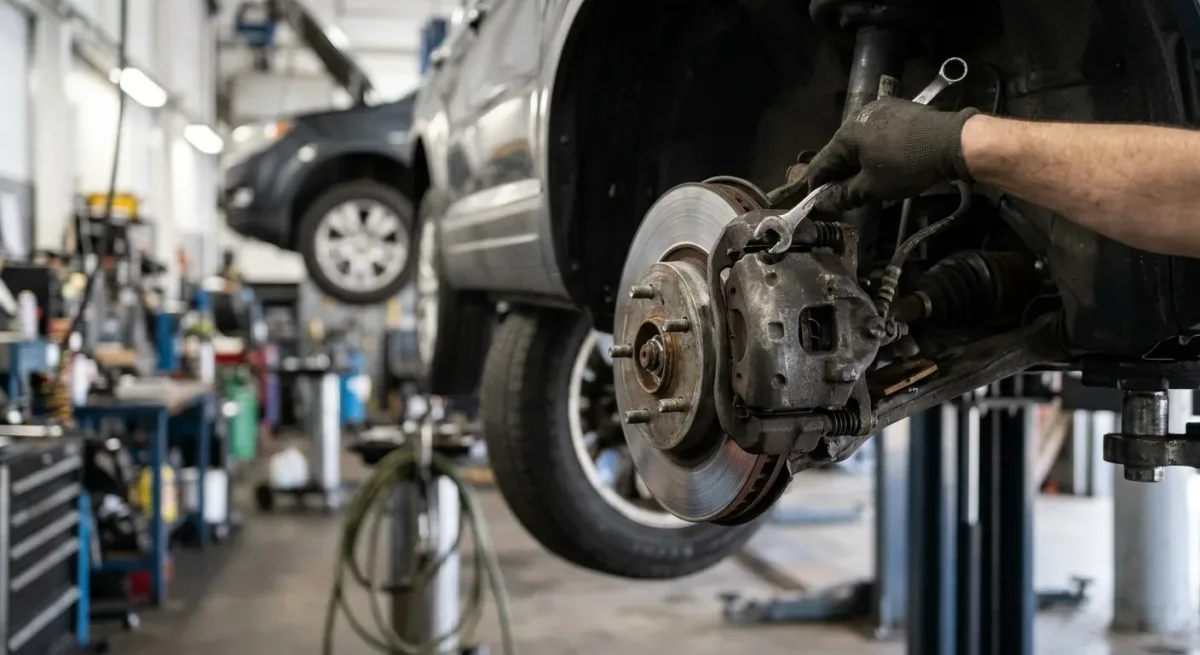
Mechanic working on brake caliper and rotor assembly under lifted vehicle in repair shop

Failure Signs

Signs Your Caliper Needs Attention

These aren't symptoms to monitor; they're reasons to call today.

Pulling to One Side

If the car drifts left or right under braking, one caliper is likely applying more force than the other. A stuck piston or seized slide pin on one side does exactly this.

Dragging After Release

When you let off the brake and the car still feels like it's fighting itself, the caliper piston isn't retracting fully. That drag generates heat, kills fuel economy, and destroys rotors.

Visible Fluid Leak

Brake fluid leaking from behind a wheel is a failed caliper seal. Don't top off the reservoir and keep driving. Brake fluid loss means pressure loss, and that affects every corner of the system.

Uneven Pad Wear

If the inner pad is ground to nothing while the outer barely touched, the caliper isn't clamping evenly. Slide pins are usually the culprit, but the caliper housing itself can be warped by repeated overheating.

  • Vehicle pulls to one side when braking
  • Brake pedal feels spongy or requires more pressure than usual
  • Grinding or squealing that continues after brake pads were recently replaced
  • One wheel significantly hotter than the others after driving
  • Visible brake fluid leak near a wheel
  • Car feels sluggish or drags even with the pedal released
  • Uneven brake pad wear: one side worn down, the other barely touched

How We Work

Repair or Replace: How Joel Decides
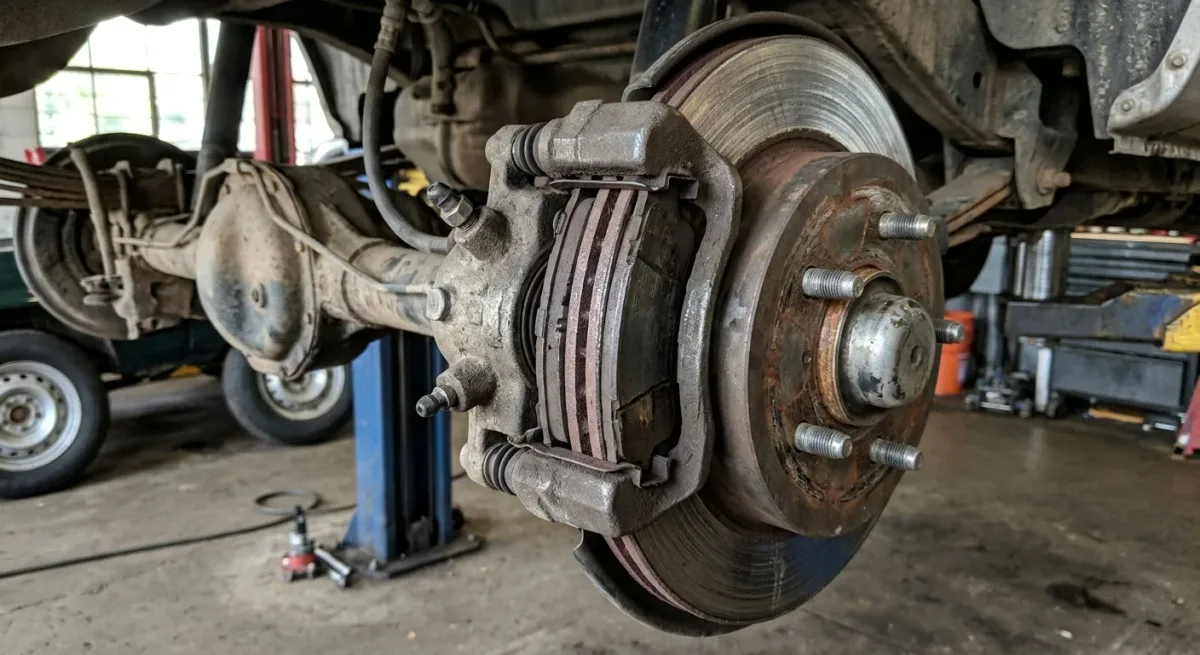
There's no universal answer here, and anyone who tells you every caliper needs replacing without inspecting it first isn't giving you a diagnosis; they're giving you an upsell. The process at Gomez starts with pulling the wheel and doing a physical inspection. Joel checks piston movement, looks for cracks in the caliper body, checks the slide pins and boots, and pressure-tests the hydraulic side before making a call. A rebuild makes sense when the caliper housing is intact and the problem is isolated to a worn seal or minor corrosion on the piston. A replacement makes sense when the housing is cracked, the piston won't compress correctly even after rebuilding, or the caliper has been running hot long enough that the metal itself is compromised. Either way, once the caliper is addressed, wheel rotation service and rotor inspection happen as part of the same visit, because a dragging caliper almost always affects rotor surface condition.
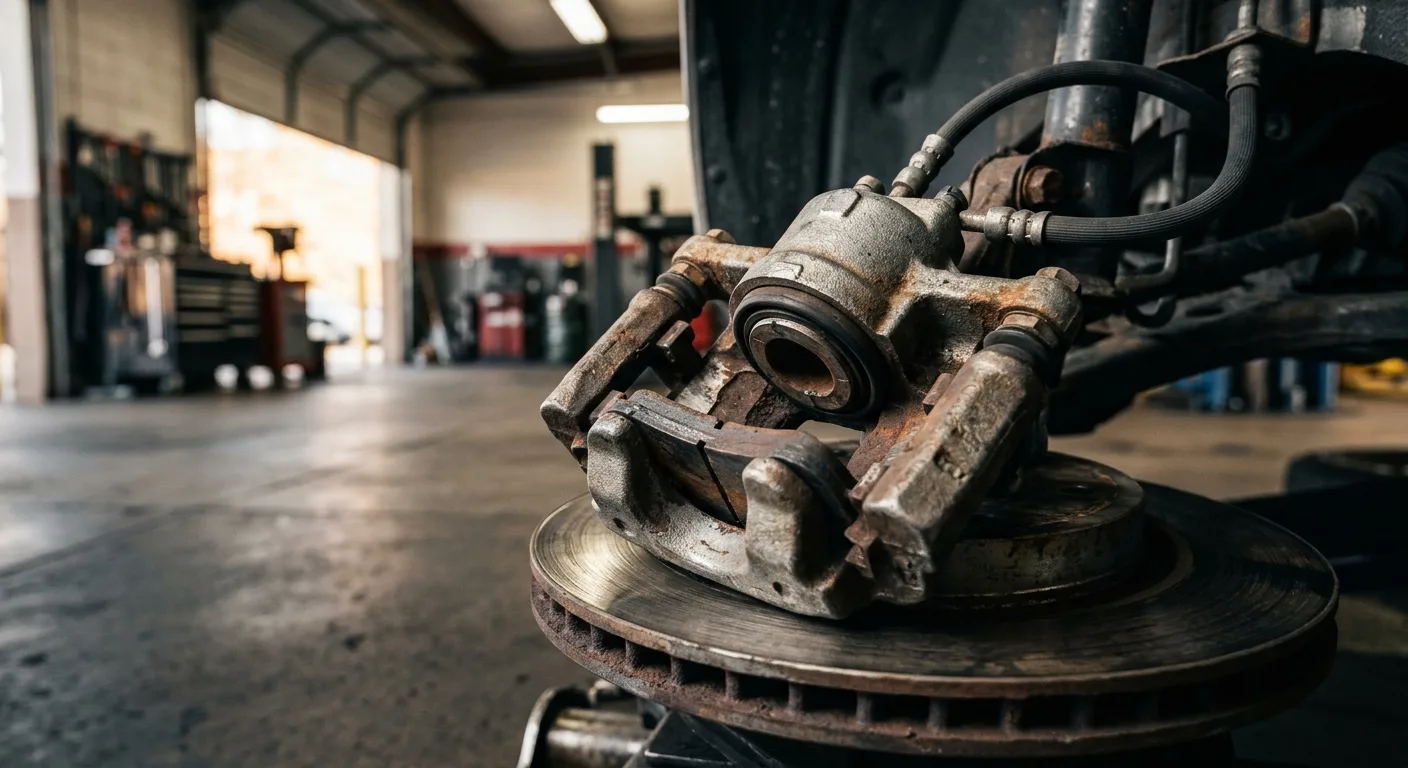
Close-up of a brake caliper and rotor assembly removed from a vehicle, showing internal brake components and wear patterns in

Our Process

What the Repair Process Covers

  1. Step 1

    Inspect and Diagnose

    Wheel comes off. Joel checks the caliper, slide pins, boots, piston travel, and rotor surface. The diagnosis is specific before any part gets ordered.

  2. Step 2

    Rebuild or Replace

    If the housing is sound, the caliper gets rebuilt with new seals and hardware. If not, a replacement caliper goes on. No guessing, no unnecessary parts.

  3. Step 3

    Bleed and Test

    New fluid goes in. The system gets bled to clear air from the lines. Then the vehicle gets a road test before it leaves the shop. No exceptions.

Houston Heat and Brake Fluid: The Connection Most Shops Skip
Brake fluid absorbs moisture over time. That's not a defect; it's just how the fluid chemistry works. The problem is that moisture lowers the boiling point of the fluid, and in Houston's summer driving conditions, brake fluid that's absorbed too much moisture can begin to vaporize under hard braking, causing what's called vapor lock: a sudden, dramatic loss of pedal. High humidity from the Gulf Coast accelerates moisture absorption compared to drier climates, which means brake fluid degrades faster here than in most other parts of the country. Old fluid also accelerates corrosion inside the caliper, attacking the piston and seals from the inside. Swapping old fluid out during a caliper service isn't an add-on; it's part of doing the job right. If you've had caliper problems before and no one mentioned the fluid, that's why they came back.
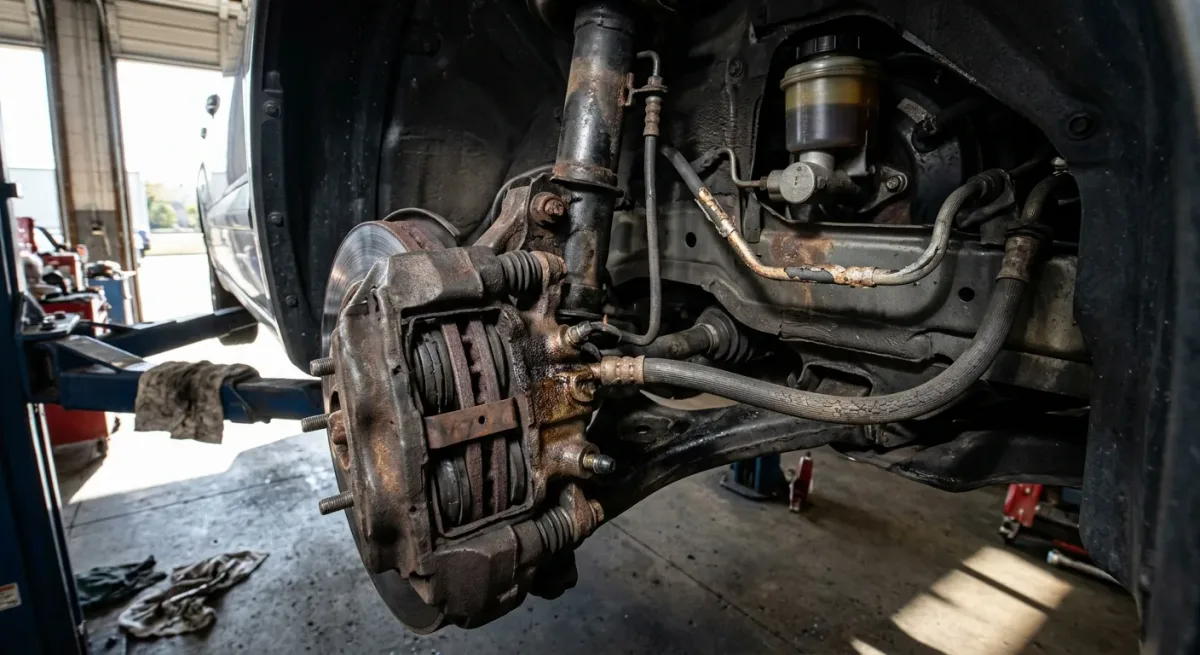
Corroded brake caliper and rotor disassembled under vehicle during service work in an auto shop.

What Else Gets Checked During This Service

Every caliper job at Gomez includes a full brake system check at no extra charge.

A caliper doesn't fail in isolation. When Joel pulls a caliper, he's already looking at the whole corner of the vehicle. If he sees a ball joint with excessive play while the wheel's off, he says something. If the sway bar links are worn, he says something. You're not going to get a list of things to come back for; you'll get the information while he has the wheel in his hand. That's the difference between an owner-operated shop and a chain. The same applies to steering hardware: if there's looseness in the tie rods that's going to affect how the alignment holds after the brake work, that's part of the conversation, not a surprise on the next visit.
Rotor surface condition measured and recorded
Slide pins and caliper hardware inspected on both sides
Brake fluid condition checked, exchange recommended if degraded
Suspension and steering hardware noted if wear is visible during disassembly

Straight from Google

What Real Customers Say About Gomez Auto Repair

4.6
46 verified Google reviews

Highly recommend this place. Owner very knowledgeable and courteous, and quoted me price beforehand, and fixed that same day! They have a waiting area to sit and watch tv.
Yvette GarzaYvette GarzaAug 2026 · Google
Don't hesitate to go to this place, I've finally found an honest mechanic
Hector DuranHector DuranFeb 2026 · Google
Great service, and they are very friendly and reliable.
fernando velascofernando velascoAug 2025 · Google
Joel is assume go see him!! Pricing is GREAT!!
Ratonda IrbyRatonda IrbyJun 2026 · Google
Go my alignment done and they also gave me a helpful advice on my tire rings very much recommend and it’s cheap too
Dhruv PatelDhruv PatelFeb 2026 · Google
You can be comfortable bringing your car to Gomez. I had an alignment done. He was able to get it in top shape after I had my whole suspension system replaced.. He’s also very kind and price friendly. Thank you Mr. Gomez.
ossports19 smithossports19 smithAug 2025 · Google
Mr. Gomez was honest and truly a godsend. I knew coming in that I would need to have major work done on my vehicle. He showed me the problems and explained in detail what needed to be done. It is always a challenge going to get mechanic work done as being a woman. I felt at ease and grateful for his expertise. I definitely will bring my family vehicles from no on.
V CruzV CruzMar 2026 · Google
Excellent shop. Got my front suspension fix in good time and price.
Miguel silvasMiguel silvasNov 2025 · Google
Every review, uneditedRead all 46 on Google
Can a brake caliper be repaired, or does it always need to be replaced?
It depends on what failed. If the piston seal is leaking but the caliper body is undamaged, a rebuild kit with new seals and boots usually fixes it. If the housing is cracked, the piston is seized solid from corrosion, or the caliper has been dragging long enough to warp the metal, replacement is the right call. Joel inspects both before recommending either.
Can I drive with a bad brake caliper?
Technically the car will move. But a sticking caliper drags against the rotor constantly, which overheats the brakes, warps rotors, and can cause a wheel to lock without warning. A leaking caliper means fluid loss, and fluid loss means reduced stopping power across the whole system. Neither is a situation where driving another hundred miles is a reasonable risk.
Why do calipers fail faster in Houston than in other cities?
Two reasons. First, Houston heat combined with stop-and-go traffic on routes like I-10 and the Beltway puts more thermal cycles on brake fluid per mile than highway driving does, which degrades the rubber seals inside the caliper faster. Second, Gulf Coast humidity accelerates corrosion on the external caliper hardware, particularly slide pins and boots, which causes the caliper to stick even when the internal seals are still functional.
Is it okay to push the caliper piston back in by hand or with a screwdriver?
It's a common DIY move, and it can damage the ABS modulator if brake fluid is forced back through the system without first removing some from the reservoir. It also doesn't address whatever caused the piston to stick in the first place. If you're pushing the piston back to install new pads without diagnosing why it was dragging, you're likely replacing pads on a caliper that will eat them again within months.
How does a sticking caliper affect my brake rotors?
A dragging caliper keeps the pad in constant light contact with the rotor even when you're not braking. That generates friction heat continuously, which creates hot spots on the rotor surface. Hot spots harden unevenly, which causes the rotor to warp, which causes the pedal pulsation most people describe as 'vibration under braking.' By the time the pulsation is noticeable, the rotor usually needs resurfacing or replacement.
Does brake fluid condition affect caliper life?
It does, and it's the part most people don't think about. Brake fluid absorbs moisture over time, which lowers its boiling point and also makes it more corrosive to internal caliper components. In Houston's humid climate, that moisture absorption happens faster than in drier markets. Old fluid corrodes the piston and seal from the inside, which is why a brake fluid exchange is part of a complete caliper service, not an optional add-on.
Is it safe to push the caliper piston back in without a proper tool?
It can damage the ABS modulator if brake fluid is forced back through the system without first removing some from the reservoir. More importantly, it doesn't address whatever caused the piston to stick. If you push it back and install new pads without diagnosing the root cause, those pads will wear unevenly again within months.
How does a sticking caliper affect brake rotors?
A dragging caliper keeps the pad in constant light contact with the rotor even when you're not braking. That generates heat continuously, creating hot spots on the rotor surface. Hot spots harden unevenly, causing the rotor to warp, which produces the pedal pulsation most drivers describe as vibration under braking. By the time that pulsation is noticeable, the rotor usually needs resurfacing or replacement.
Does brake fluid condition affect how long calipers last?
It does. Brake fluid absorbs moisture over time, which lowers its boiling point and makes it more corrosive to internal caliper components. In Houston's humid climate, that moisture absorption happens faster than in drier markets. Old fluid corrodes the piston and seal from the inside, which is why a brake fluid exchange is part of a complete caliper service here.

Open Six Days. Call Joel Before the Problem Gets Bigger.

4.6 stars across 46 Google reviews. Owner on-site every day the shop is open.

Shop hours

  • Mon 8:30 AM–6 PM
  • Tue 8:30 AM–6 PM
  • Wed 8:30 AM–6 PM
  • Thu 8:30 AM–6 PM
  • Fri 8:30 AM–6 PM
  • Sat 8:30 AM–6 PM
  • Sun Closed
152 W Mt Houston Rd, Houston Directions

Related

Next step

Tell us about the job

Your name, your number and what needs doing. A person from Gomez Auto Repair Services Llc gets back to you.

Rather talk now?(832) 991-9850Mon–Sat: 8:30 AM–6 PM · Sun: Closed

No obligation


By submitting this form you agree that we may contact you about your request and share your name and email address with partner companies for email marketing. We never share your mobile number or text message consent with third parties or affiliates for marketing or promotional purposes.