
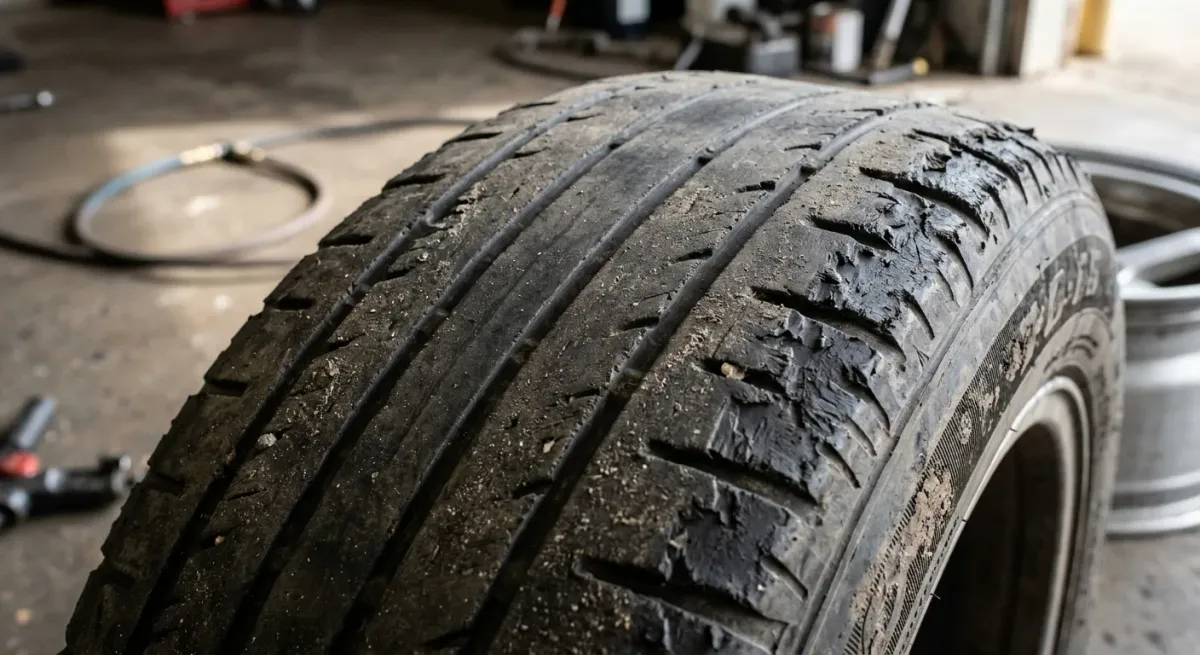
Control Arm Repair
If the ball joint is pressed into the control arm and the arm is bent or the bushing is gone, we handle the full control arm repair in-house. No second shop needed.
Houston Local
4.6 from 46 Google reviewsWorn ball joints are a safety issue, not a "schedule it later" kind of problem.
Hover the car to X-ray itTap a part to X-ray it
What does your car need?
Overview
Ball joint replacement in Houston is one of the more urgent suspension repairs you can have done, and Gomez Auto Repair Services LLC at 152 W Mt Houston Rd handles it in-house on most makes and models. If your steering feels loose, you hear a clunking noise going over bumps, or your front tires are wearing unevenly, a failed ball joint is one of the first things worth checking. A ball joint that lets go while you're driving isn't just an expensive tow call, it's a vehicle that suddenly can't be steered. Call Joel at (832) 991-9850 before it reaches that point.
Ball joints connect your control arms to your steering knuckles, and they carry the full weight of the vehicle through every bump and turn. Houston's roads don't do them any favors. The potholes on the west side, the constant stop-and-go on the Southwest Freeway, the humidity that works into every rubber boot and causes corrosion on the joint housing itself, all of that shortens the life of suspension components faster than a highway town would. Lower ball joints tend to wear before upper ones because they're load-bearing, but we check both when we're in there. Replacement involves pressing out the old joint, pressing in the new one, and doing a wheel alignment afterward to make sure the geometry is set correctly. Cost varies based on which joints need replacing, your vehicle's make and model, and whether we find related damage like a torn control arm bushing or a bent knuckle. Every job is different, so contact Gomez Auto Repair Services LLC for an accurate estimate.
These symptoms can point to a ball joint problem, but a few of them get misdiagnosed regularly.
A worn ball joint knocks when the suspension travels. It's most obvious on speed bumps, dips, or rough pavement. Some people assume it's a shock or strut, but if it's localized to the front corner, the ball joint is a strong candidate.
If the car drifts or the wheel feels vague, that play can come from a worn joint allowing unwanted movement in the steering knuckle. It's not always the rack.
A joint that's worn enough to let the wheel change angle will eat tires on the inside or outside edge. Alignment won't fix it if the ball joint is still loose underneath.
Not every vibration is wheel balance. A failing joint can cause a shimmy that gets worse as speed increases, especially on highway on-ramps and elevated sections.
If the car pulls even after a fresh alignment, the steering geometry may be shifting because the joint won't hold position. That's a sign the problem is mechanical, not just a spec issue.
A dry or cracked ball joint boot lets moisture and grit into the joint. The first warning is often a squeak on slow turns. It moves quickly from squeak to clunk to failure.
The Work Itself
Step 1
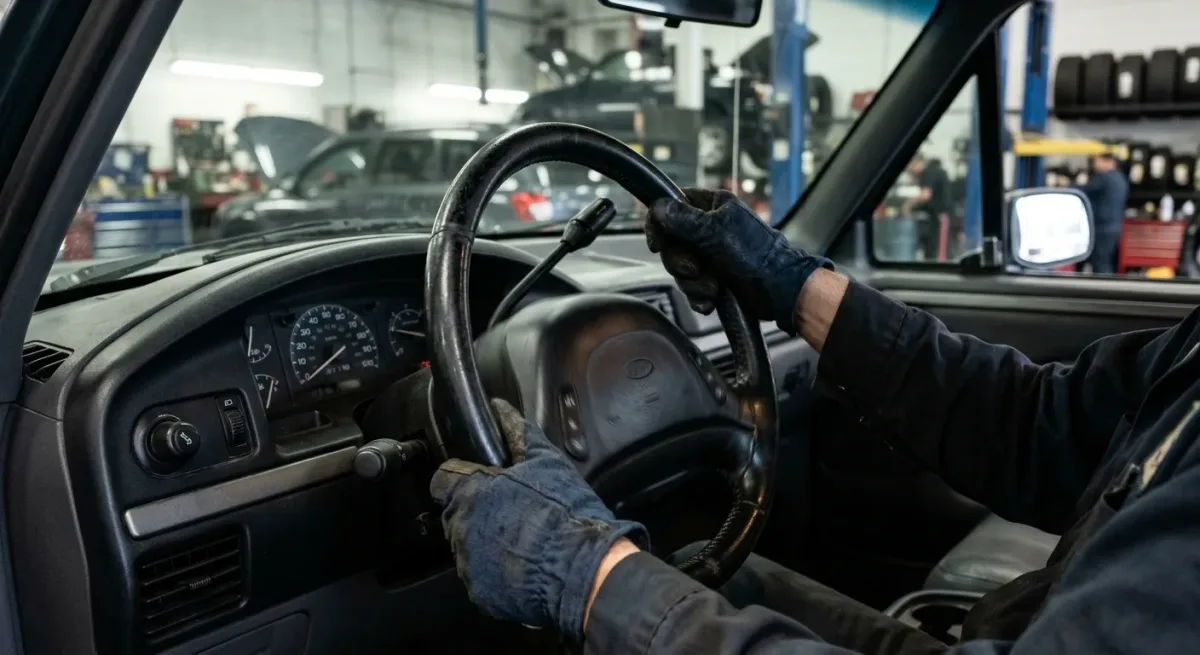
We lift the vehicle, grab the wheel at 12 and 6, and check for play. We also check the boot condition and listen to what the joint does under load. If we see wear in the control arm or tie rod while we're in there, we tell you before we start wrench work, not after.
Step 2
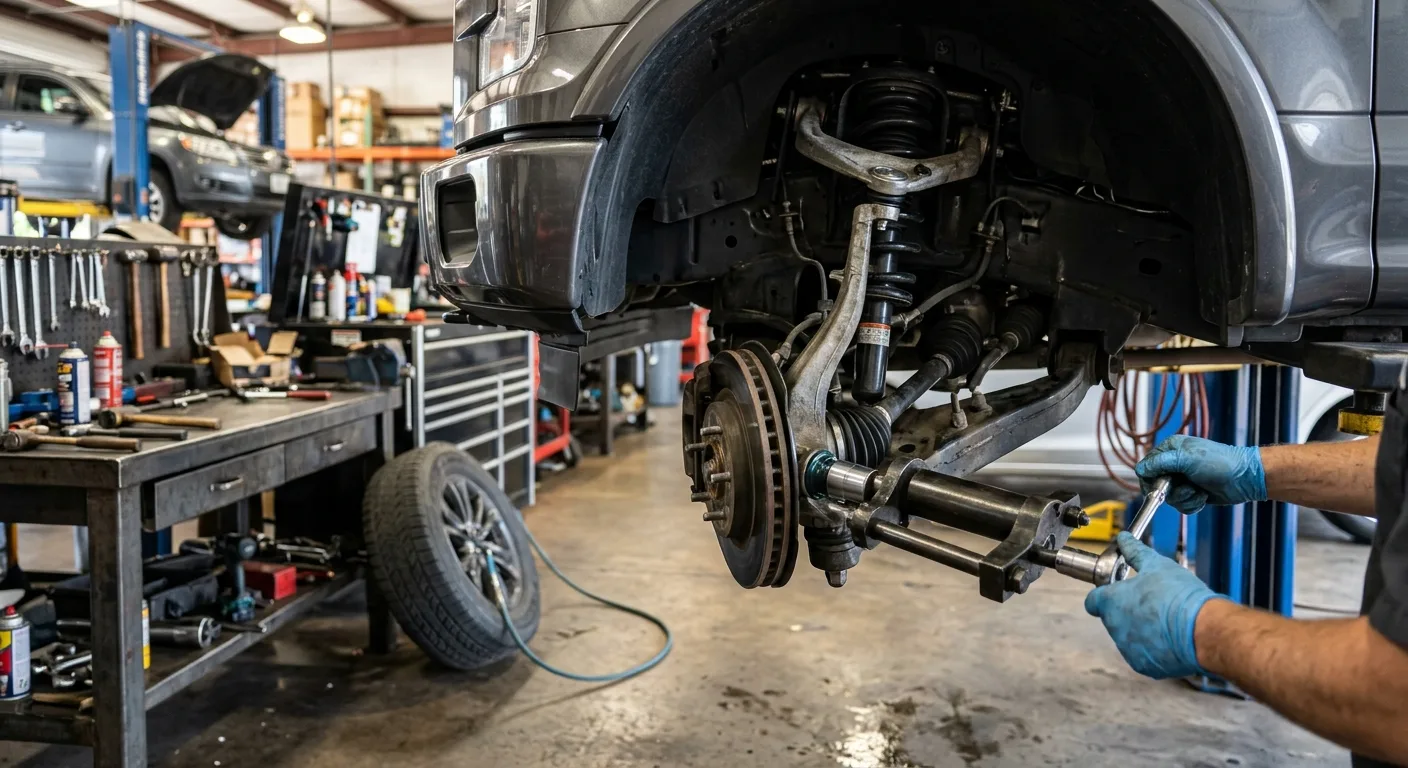
Ball joints are pressed into the control arm. Getting them out without damaging the arm requires the right press equipment, not a hammer and drift. We press out the worn joint, clean the bore, and press the new joint to spec. On some vehicles the entire lower control arm is replaced as a unit.
Step 3
Any suspension work that changes ride height or geometry requires a fresh alignment. We do 4-wheel alignment in-house, so you don't have to make a second stop after the repair. Skipping the alignment after a ball joint replacement is how tires wear out in three months.
Safety First
Ball joints rarely wear in isolation. Here's what we commonly find alongside them.
If the ball joint is pressed into the control arm and the arm is bent or the bushing is gone, we handle the full control arm repair in-house. No second shop needed.
Worn shocks put extra stress on ball joints by allowing more suspension travel than the joint was designed for. We replace shock absorbers in-house and often find both need attention at the same visit.
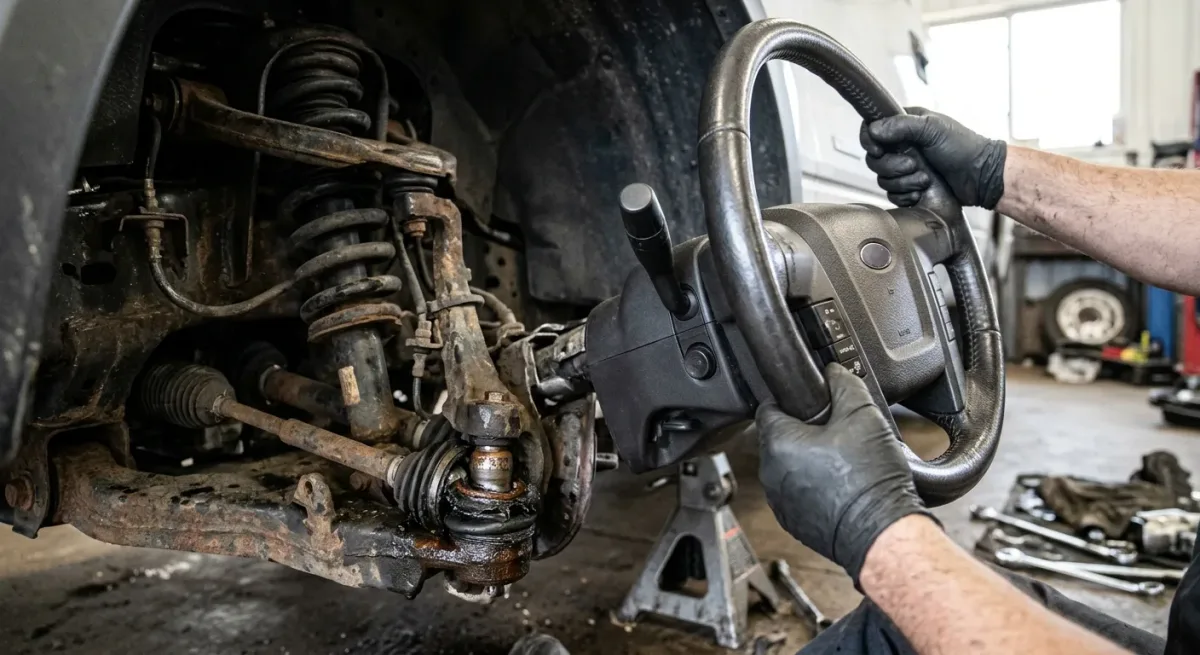
Loose steering that gets blamed on ball joints is sometimes the rack. We diagnose and do rack and pinion repair in-house, which is work most general shops refer out.
If a CV axle is clicking on turns, it's often caught at the same inspection as a ball joint. Addressing both at the same visit saves labor compared to two separate appointments.
On trucks and older SUVs with solid front axles, the center bar link is part of the steering geometry. We replace them when the steering develops excessive play.
This isn't just a sales line. Houston's infrastructure genuinely accelerates suspension wear.
The combination of heat that hardens and cracks rubber boots, humidity that corrodes the joint housing once the boot fails, and pothole-heavy roads in neighborhoods like Alief, Gulfton, and Sharpstown means ball joints on vehicles driven in this city take a beating that a vehicle in a drier, smoother market wouldn't. Proximity to the coast adds salt air to the equation for vehicles that spend time near Galveston or the Ship Channel.
We see more corrosion-related suspension failures than rust-belt cities do, because Houston drivers aren't looking for it. The joint looks fine on the outside until the boot splits and the housing corrodes from within. If your vehicle has more than 70,000 miles and hasn't had a suspension inspection, it's worth having Joel take a look. Call (832) 991-9850 or stop by 152 W Mt Houston Rd any day Monday through Saturday.
What you get when you bring your vehicle to Gomez Auto Repair Services LLC
Call (832) 991-9850
Shop hours
Next step
Your name, your number and what needs doing. A person from Gomez Auto Repair Services Llc gets back to you.
Rather talk now?(832) 991-9850Mon–Sat: 8:30 AM–6 PM · Sun: Closed